> For the complete documentation index, see [llms.txt](https://docs.microside.com/llms.txt). Markdown versions of documentation pages are available by appending `.md` to page URLs; this page is available as [Markdown](https://docs.microside.com/practicas/pic-c-compiler-ccs/pic16f887-or-pic16f877a/11-motor-dc-+-driver-l298n.md).
# 11 - Motor DC + Driver L298N
> **PIC C Compiler CCS**
>
> [**PIC16F887 / PIC16F877A**](https://docs.microside.com/practicas/pic-c-compiler-ccs/pic16f887-or-pic16f877a)
## **Introducción**
En esta práctica se implementa el control de un motor de corriente directa, usando el módulo PWM (modulador de ancho de pulso) para aumentar o disminuir la velocidad y un driver LM298N para realizar un cambio de giro.
## **Descripción**
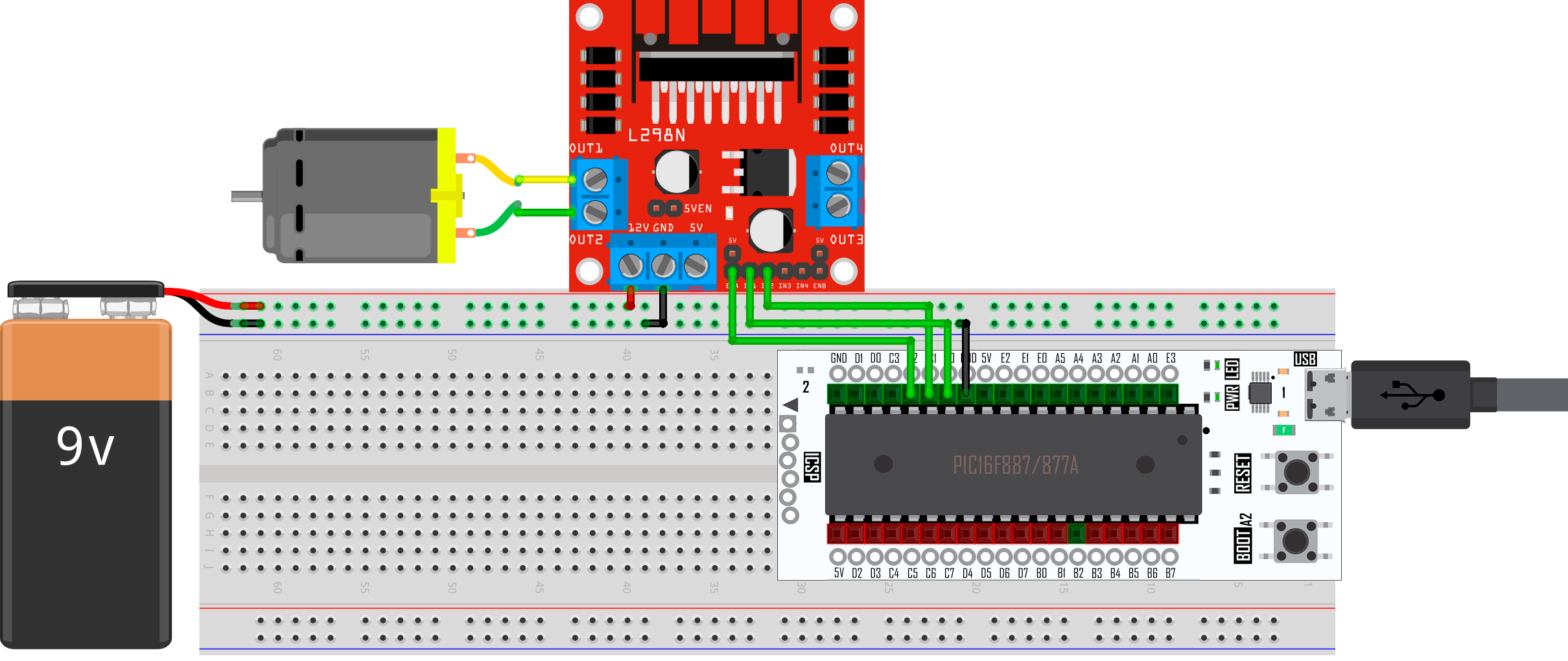
En esta práctica se usa el módulo PWM (Pulse Width Modulation) del pin C2, para el aumento y disminución de la velocidad de giro de un motor DC. Con ayuda de un driver LM298N que se encuentra conectado a los pines C0 y C1 de la tarjeta **X-TRAINER** con el **PIC16F887/PIC16F877A,** se realiza una inversión de giro.
**Materiales:**
1 x Tarjeta **X-TRAINER**. [**Manuales**](https://docs.microside.com/tarjetas-de-desarrollo/x-trainer) | [**Comprar**](https://www.microside.com/shop/category/entrenadores-pic-1)
1 x Driver L298N.
1 x Motor DC 5 a 12 volts.
1 x Pila de 9 volts.
1 x Conector para pila cuadrada de 9 volts.
1 x Protoboard de 830 puntos.
1 x Juego de cables Dupont.
1 x Cable micro USB.
**Software:**
Windows 8.1 o posterior.
PIC C Compiler v5.069 o posterior. [**Descarga**](http://www.ccsinfo.com/ccsfreedemo.php)
X-TRAINER Suite v1.0 [**Descarga**](https://raw.githubusercontent.com/MICROSIDE-TECHNOLOGY/microside_download_archive/main/Tools/X-TRAINER%20Suite/X-TRAINER%20Suite%20Setup.zip)
## **Procedimiento**
**1.** En el apartado de “[**Diagrama Esquemático**](#diagrama-esquematico)” selecciona el modelo de tu tarjeta, realiza las conexiones que se muestran en la imagen y conéctala a la computadora.
{% hint style="info" %}
Las conexiones mostradas en los diagramas esquemáticos son las mismas ya sea que la tarjeta **X-TRAINER** posea el **PIC16F887** o el **PIC16F877A**.
{% endhint %}
**2.** Ejecuta **PIC C Compiler**, crea un nuevo proyecto con el código fuente que se encuentra en el apartado "[**Código**](#codigo)" y compila el programa.
{% hint style="success" %}
Si tienes dudas de cómo realizar los pasos anteriores puedes encontrar un manual de **PIC C Compiler** a través del siguiente [**link**](https://docs.microside.com/practicas/ides/pic-c-compiler-ccs).
{% endhint %}
**3.** Abre el **Software X-TRAINER Suite v1.0** en el apartado **PIC16F877A/887**, selecciona el archivo .hex generado al compilar el proyecto y programa la tarjeta.
{% hint style="success" %}
Si tienes dudas de cómo realizar los pasos anteriores puedes encontrar un manual del **Software X-TRAINER Suite v1.0**. a través del siguiente[ **link**](https://docs.microside.com/tarjetas-de-desarrollo/software-x-trainer-suite).
{% endhint %}
**4.** Al terminar de programar, la tarjeta **X-TRAINER** se reiniciará automáticamente y se ejecutará el programa de esta práctica.
## **Diagrama esquemático**
Selecciona el modelo de tu tarjeta **X-TRAINER.**
{% tabs %}
{% tab title=" LITE M R2" %}
{% endtab %}
{% tab title="LITE M R3" %}
{% endtab %}
{% tab title="LITE F" %}
{% endtab %}
{% tab title="PRO R3" %}
{% endtab %}
{% tab title="PRO R4" %}
{% endtab %}
{% endtabs %}
## **Código**
{% tabs %}
{% tab title="PIC16F887" %}
{% embed url="" %}
{% endtab %}
{% tab title="PIC16F877A" %}
{% embed url="" %}
{% endtab %}
{% endtabs %}
## **Descargas**